How Does A Root Canal Form?
The term root canal strikes fear in patients and dentists alike. They ...



Have you chipped a tooth? Or were you hit in the face playing a contact sport? Maybe you’ve had multiple repeat fillings on the same tooth? If you’ve said ‘yes’ to any of these, it means you may need a root canal.
Everybody used to dread getting a root canal. Just simply hearing and feeling your dentist go deep into a particular tooth just felt like an out-of-this-world experience.
Mostly because we’ve all known root canals to be painful procedures. However, most people report that the level of pain involved is overstated and similar to the placement of a filling.
In recent years, local anesthetics have been used to freeze your tooth so that your root canal treatment is pain-free. Be sure to ask your dentist about this.
To many, the concept of a root canal may sound foreign. So in this blog post, we’ll go over what root canals are, why they are needed, how you know you need root canal therapy and how root canals are done.
A root canal is a dental treatment used to repair and save a badly decayed or infected tooth. The procedure is carried out to remove the nerve and dental pulp when they get infected or badly damaged. After removal of nerve and pulp, the tooth is cleansed and sealed.
It may also mean some extended procedures need to be done, like tooth extraction, dental bridge, dental implant, and/or removable partial denture.
Root canal therapy becomes inevitable when your tooth decays or gets damaged badly due to trauma or any other reason. Therapy is needed when a tooth’s pulp becomes inflamed and infected due to a number of reasons:
The dental pulp is the ‘chamber’ of your tooth. It’s where the nerve, blood vessels and connected tissue are. When the pulp is damaged, it breaks down and bacteria spreads across the entire chamber. It multiplies and guess what – multiplying bacteria isn’t a good thing!
The bacteria, along with other dying remnants of the chamber can work together to cause an infection of an abscessed tooth.
When the bacteria enter into your tooth, they attack your nerves and stop blood supply to it which ceases the antibacterial cells to transmit and fight against them.
Root canal therapy is usually suggested by your dentist after teeth examination. However, there are signs that may indicate that you may need a root canal therapy as the suggested course of treatment. These signs include;
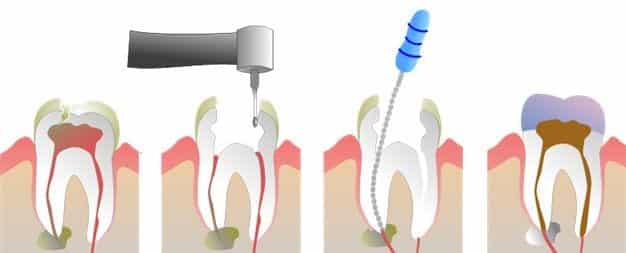
Root canal therapy, sometimes referred to as endodontic therapy or treatment, may be performed by an endodontist or a general dentist. Your dentist may require 2 or 3 visits to perform the treatment in phases.
Prior to treatment, X-rays are taken to check the severity of damage.
Finally, your tooth is protected from future damage and restored to its normal condition. This is done by placing a crown which could be made up of gold or porcelain, tinted to match the color of your teeth to give natural look.
Once your root canal treatment is done, your tooth can function normally. By taking care of it and maintaining good oral hygiene, you can protect your teeth from future decaying or damage.
In the first few days, your tooth may be sensitive that can be treated using over-the-counter medicine. If the problem persists, be sure to talk to your dentist.
If you’re experiencing pain or discomfort, don’t wait. Take action now and see your dentist. Don’t let your tooth decay further! Our team at LA Dental Clinic can alleviate your pain and provide immediate root canal therapy for you. Book a consultation today!

LA Dental Clinic
3377 Wilshire Blvd #202
Los Angeles, CA, 90010
